
A picture of the whole path
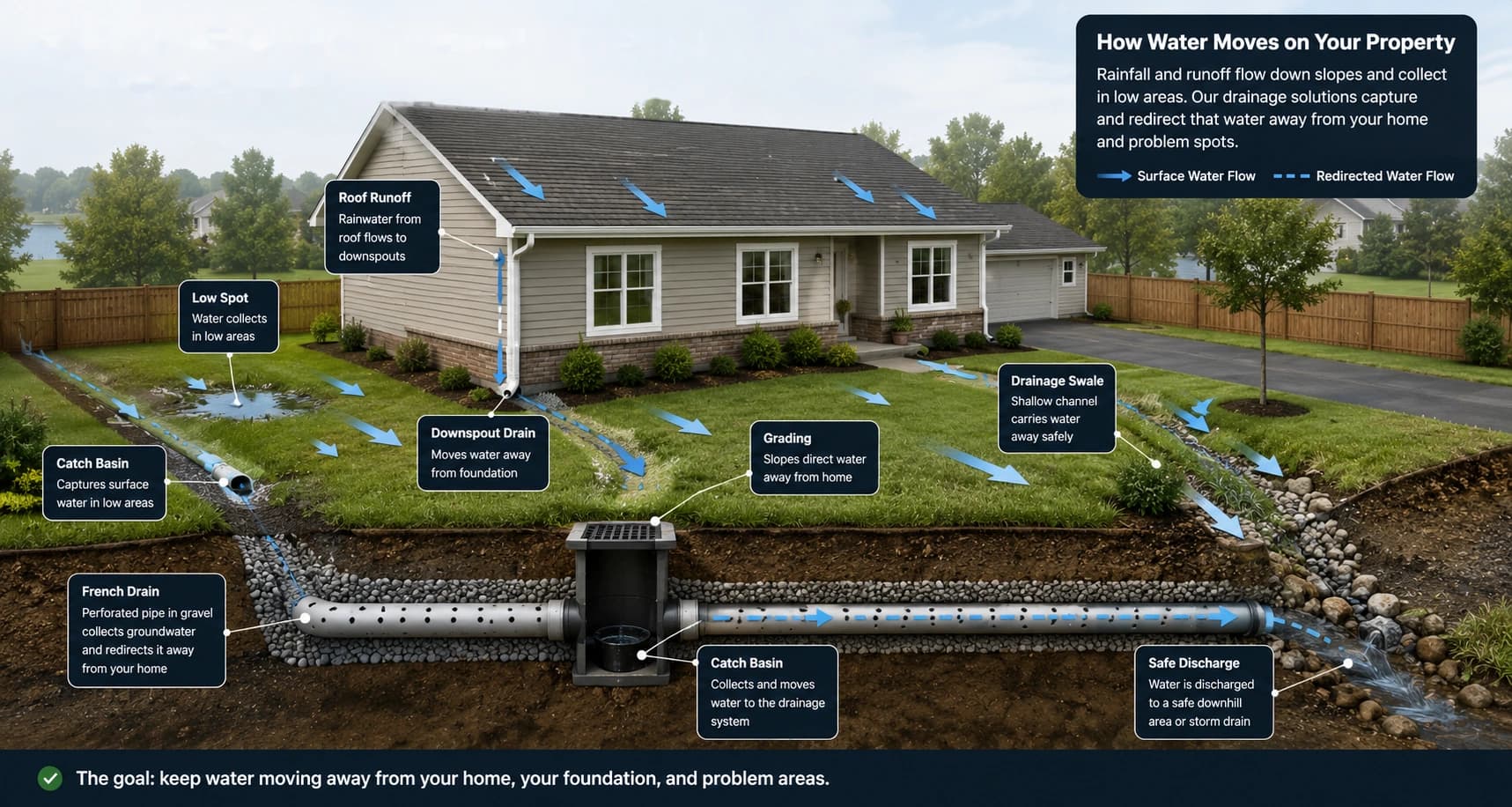
Roof water, surface runoff, and water in the soil are different feeds. The schematic below is the approved homeowner map of those pieces. It is a teaching drawing, not a design for a specific lot.
Where is the water coming from?
Rain on the lawn is the obvious feed. It is not the only one.
Roof runoff is concentrated. A few downspouts handle an entire roof plane. Neighboring or uphill surface water can sheet onto a lot. That is geography of flow, not a claim about who is legally responsible.
Water already in saturated soil is a slower feed. It does not need a visible puddle to keep a lawn soft. Yard drainage starts by naming which of those is actually arriving.
- Rainfall landing on the grass, walks, and beds
- Roof runoff at downspout outlets
- Surface runoff traveling from higher ground
- Groundwater moving through soil that will not dry
Where is the water collecting?
Collection is the symptom you notice. Low bowls hold a pond. The strip along the house stays wet. A side yard between homes turns to mud. A lawn is spongy with no puddle. A downspout carves a hole in the planting bed.
Those are different collection points. Yard drainage problems maps the symptoms. The collection point tells you whether you need a hole at the surface, a trench in the soil, a better roof-water path, or a change in slope.
Where can the water safely go?
Nothing on this site deletes water. Every method relocates it.
A surface path or swale lets runoff travel a better direction. A catch basin takes a pond at a grate and pipes it. A French drain takes water already in the soil. Downspout drainage moves roof water before it soaks the same strip. Grading changes the shape that was trapping or misdirecting flow.
The discharge point has to be appropriate for that property. This page does not list municipal rules for streets, storm connections, or neighbors. Those are checked for the job, not copied from a webpage. Where does French drain water go? is the outlet-focused guide.
What a French drain is doing in that picture
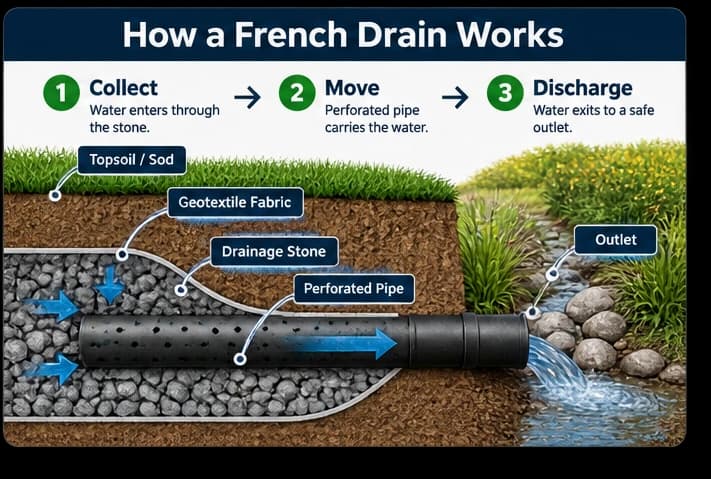
Below-ground, water enters stone, reaches a perforated pipe, and needs a real exit. The diagram is the close-up of that one tool — not the whole yard.
The methods in that model
Each service page is one piece of the path, not a complete substitute for the others.