
What a swampy yard usually looks like
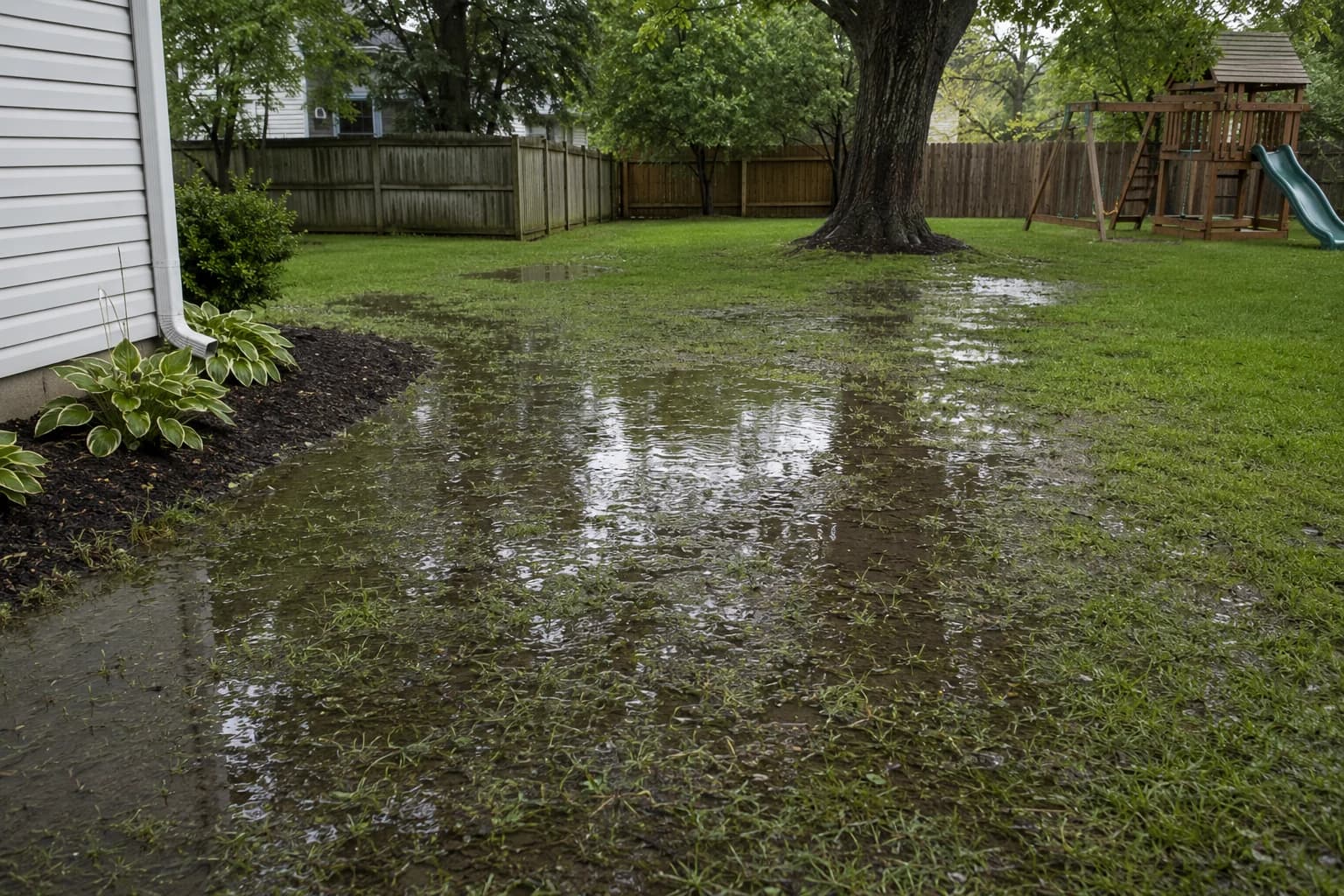
Homeowners notice the lawn as a season, not a storm. A patch stays dark and soft. Mower wheels leave ruts that never heal. Kids avoid one corner most of the year.
There may be a puddle after rain. The swampy pattern is what remains when the sky has been clear: ground that never fully firms up.
- The same area is wet much of the time, not only during storms
- The lawn rarely feels firm underfoot
- Mud returns in the same footprint through the wet season
- A corner of the yard is unused because it never dries
Why a yard can stay that wet
A chronically wet lawn is usually one of four feeds — or a stack of them. Surface runoff that never leaves a low area. Water already in the soil with no exit. Grade that sends every storm into the same pocket. Roof water that keeps recharging a strip along the house.
Name the feed before naming a drain. A swampy corner that is really a downspout splash is not the same job as a lawn that stays saturated with the downspouts already discharging away.
- Surface runoff sitting in a low area with no path out
- Saturated soil that never firms up between storms
- Slope that sends water into the wet zone
- Roof water that never leaves the splash zone
A wet yard does not automatically mean you need a French drain
A French drain is a gravel trench with perforated pipe. It is built for water already moving through the soil. It is a strong tool for that job. It is the wrong first tool if the water is still sitting on top of the lawn, or if the ground is shaped to send every storm into a bowl.
Surface water that ponds in a visible low spot often needs a catch basin or surface drain — a grate at the puddle, then a pipe to an outlet. If the yard tilts the wrong way, grading or a shallow swale may have to come first so water has a path at all.
Roof runoff that lands next to the house is often a downspout drainage problem. Extending or burying that discharge can dry a swampy strip along the foundation without a trench across the whole yard.
Saturated soil that never firms up — even when you cannot point to a puddle — is where a French drain becomes relevant. Match the method to the feed, not to the word “swampy.”
How to tell which kind of water you are looking at
Ask which feed you have, not how many days it took to dry after the last storm. If you can point to a puddle in a dish of lawn, that is surface water. If the ground is spongy in a broad area with no pond, water in the soil is part of it. If the wettest ground sits under a downspout, start with the roof. If the lot tilts into that corner, slope is in the picture.
That filter is for a chronically swampy yard. Yard drainage is the hub if more than one feed is obvious.
What a contractor should look at
A useful visit traces the water instead of selling a product name. The questions are the same on most swampy lots, even though the answers are not.
- Where water first appears after rain
- Whether it is on the surface, in the soil, or both
- The low points and the direction of slope
- How downspouts currently discharge
- Whether an existing drain, swale, or basin is already in play
- A realistic place for water to outlet without creating a new wet spot
Drainage solutions that may apply
Read the service that matches the water you are seeing. The swampy-yard problem is the symptom; these pages are the tools.