
What a wet side yard usually looks like
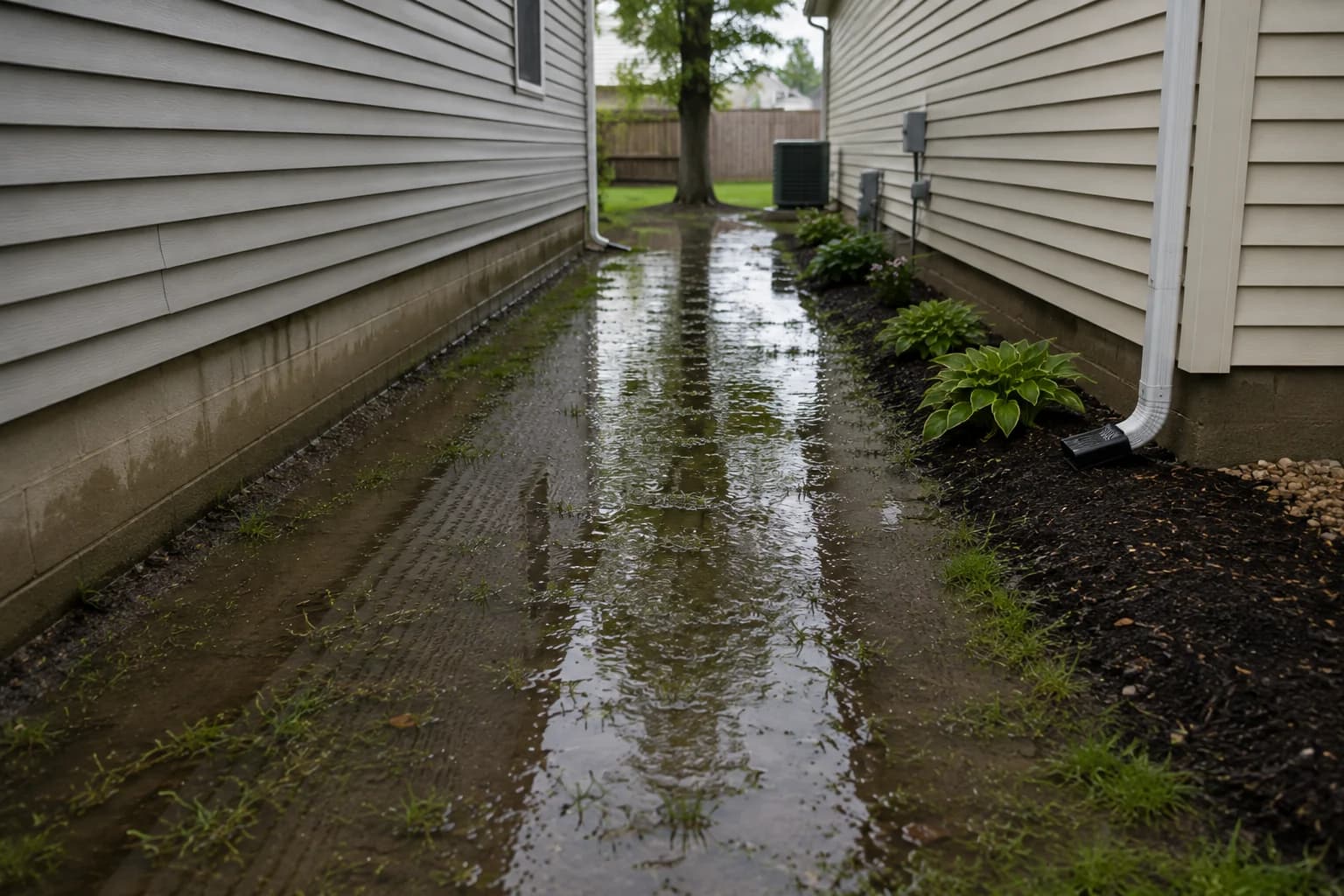
After rain, the path between homes is the wettest ground on either lot. Water may sheet down from the front, collect at a gate, or sit along a fence line.
The space is often too tight for mowing when it is wet, and too tight for an obvious “just regrade the whole yard” answer. That is why the diagnosis has to be specific: where the water enters the corridor, and whether it can leave.
- A narrow side yard that ponds or stays muddy
- Runoff entering from the front, a driveway, or both roofs
- Water trapped along a fence or against both foundations
- No obvious downhill exit at the back of the strip
Why that corridor collects water
Two houses close together leave a low slot. Surface water from both lots can drain toward it. Downspouts on the facing walls empty into the same few feet of soil. A shared grade that was never given a swale or a drain leaves the water with nowhere obvious to go.
Limited slope makes it worse. If the strip is flatter than the front and back yards, water arrives and stalls. Concentrated discharge — one strong downspout, a patio edge, a driveway apron — can turn that stall into a standing pool.
This page does not assign legal responsibility for a neighbor’s runoff. It describes the water you can see on your side, and the exterior drainage options that can move it once there is a workable outlet.
What can actually fit between houses
A catch basin or surface drain is often the practical collector in a tight side yard: a grate at the true low point, then a pipe out the back or to an appropriate outlet. A shallow swale can work if there is enough width to shape one without crowding both foundations — see grading and swales.
Downspout drainage belongs in the plan whenever a roof outlet is feeding the corridor. Carrying that burst underground or farther downslope can drop the load on the strip even before a yard drain is added.
A French drain may help if the soil in the corridor stays saturated after surface water is collected. It still needs room for a trench and an outlet. In a slot that only ponds on top, the grate is usually the more direct tool.
Yard drainage is how those pieces get chosen for one property instead of treating the side yard as a generic wet-lawn problem.
What to look at in a side yard
- Which downspouts empty into the strip — yours, and any you can see on the facing wall
- Whether water enters from the front yard or a driveway
- The low point: gate, fence, midway, or against one house
- Whether there is fall toward the backyard or the street
- How much width exists for a grate, a shallow swale, or a trench
- A discharge path that does not simply flood the backyard
Related drainage solutions
Side yards usually need a collector, a downspout plan, or a shallow path — sometimes more than one.