
Problems that often start at a downspout
If the wettest ground on the property sits under or beside a downspout, start here before assuming the whole yard needs a French drain.
- Water pooling beneath downspouts after rain
- Erosion or a washed-out mulch bed at the splash block
- A soggy strip along the house where roof water lands
- Repeated concentrated runoff in the same landscaping bed
- Water flowing back toward the house from a short splash block
- Saturated planting areas that stay wet between storms
How downspout drainage is handled
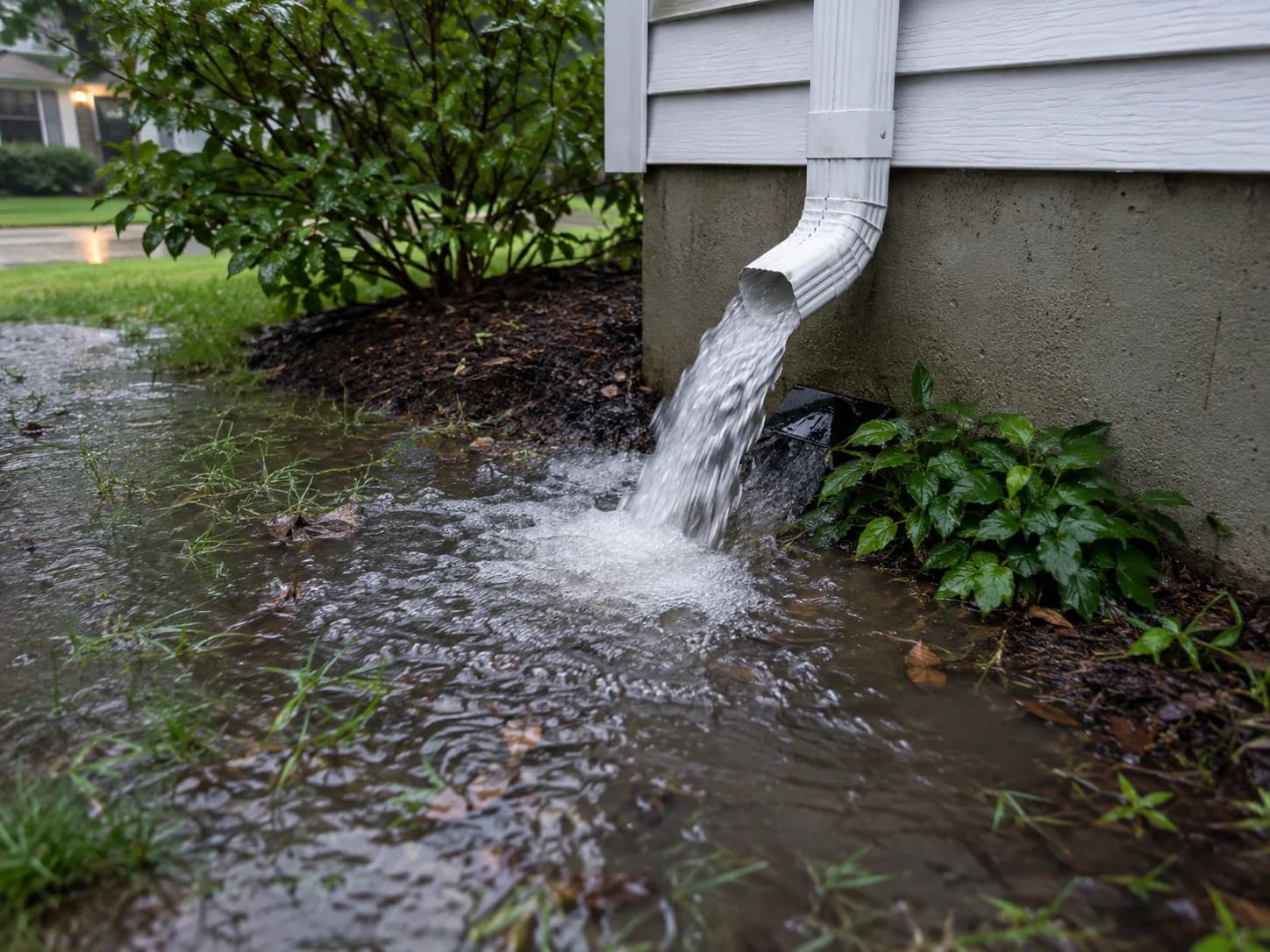
The simplest version is carrying the water farther away on the surface with an extension, aimed at a place that already drains. That only works if the ground falls away from the house and the extra water will not soak a walk or a neighbor.
When an above-ground extension is impractical, an underground line can take roof water from the downspout to a farther discharge point. That line is a solid pipe with a job: move a burst of roof water, then empty.
Some properties connect downspouts into a larger exterior drainage plan — a catch basin, a daylight outlet, or a system that already has a safe place to dump water. The connection has to be designed so roof flow does not overload a line meant for slow groundwater.
Safe discharge is the test. Roof water is a lot of water in a short time. Releasing it in another low corner of the same yard just relocates the puddle.
Downspout drainage vs. a French drain
If the only wet area is the splash zone under a downspout, fix the downspout path first. A French drain under that spot can mask a discharge problem without stopping the roof water from arriving.
If roof water is one source among several — a low side yard, poor slope, saturated soil farther out — downspout work is often combined with grading, a surface drain, or a French drain.
A catch basin can catch downspout water that already hits the ground. An underground downspout line can keep that water off the ground entirely until the outlet. Which one is cleaner depends on the layout of the house and the yard.
What to look at around the roof and yard
Downspout drainage fails when someone extends a pipe without checking where the water will land.
- How many downspouts dump near the house
- Whether splash blocks point toward a low area or back at the foundation planting
- The slope within the first 10–15 feet of each downspout
- A discharge location that can accept a heavy burst of roof water
- Existing underground lines, catch basins, or yard drains that could be used honestly
- Walks, AC pads, and plantings that block a simple extension
Related drainage solutions
Roof runoff is often one piece of a larger exterior drainage plan.