
What standing water after rain looks like
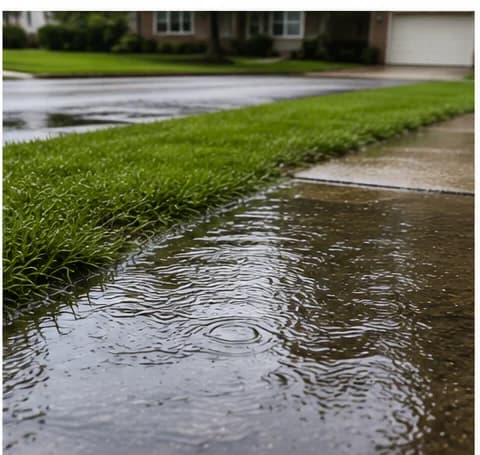
You can usually point to it. A dish in the lawn. A corner of the patio. A dip at the edge of a driveway. The water has a shape.
It may drain in a few hours or sit until the next dry stretch. Either way, the yard is telling you that location is the bottom of the local slope — or that compacted ground there is not taking water in.
- A puddle in the same footprint after every storm
- A low spot you can see even when it is dry
- Runoff from a driveway or patio ending in one corner
- Water that has no channel, swale, or grate to enter
Why puddles form and stay
Water follows the lowest path. If that path ends in a bowl, the bowl fills. If the ground around the bowl is flatter than it looks, there is no momentum to carry the water out.
Concentrated discharge makes it worse. A downspout, a low pavement apron, or a neighbor’s grade can dump a lot of water into one place. The lawn never had a chance to pass that volume along.
Some areas also take water in slowly. Compacted soil, dense thatch, or a tight clay pocket can leave a skin of water on top. That is not a verified soil map of Rockford. It is a pattern you can observe: rain hits, sits, and soaks late.
Standing water vs. saturated soil
Standing water is what you see. Saturated soil is what you feel. They often show up on the same lot. They are not the same drainage problem.
A puddle on the surface wants a surface answer: a path, a swale, a grate. Catch basins and surface drains collect that water at the low point. Grading and swales change the shape so the water never ponds there — or so it can reach the grate.
Saturated soil is water already in the ground. The lawn can be spongy with no puddle at all. That is closer to French drain territory: a gravel trench that gives groundwater a route to an outlet.
Installing a French drain under a surface puddle without fixing the bowl can leave the puddle in place. Installing only a grate in a lawn that stays wet everywhere can miss the groundwater. Watch which one you actually have — or whether you have both.
Possible solutions, based on the cause
If you can cover the puddle with a grate, a catch basin or surface drain is often the direct tool — provided the pipe has somewhere appropriate to discharge.
If the whole area is a shallow dish, reshaping the grade or cutting a swale may remove the pond without a structure in the lawn. If a downspout is feeding the puddle, downspout drainage should be in the plan before anyone trenches the rest of the yard.
A French drain enters the conversation when the ground around the puddle stays saturated, or when surface water soaks in and then has no subsurface path. Yard drainage is how those pieces get sequenced on one property.
What to evaluate at the puddle
- The exact low spot and how large the contributing area is
- Whether hardscape or a downspout concentrates the flow
- Whether the surrounding lawn is only wet at the puddle or spongy beyond it
- A pipe path with fall to a real outlet
- Whether a small grade change would send water to an inlet — or off the low area entirely
Related drainage solutions
Standing water is usually a surface problem. Saturated soil around it may still need a below-ground drain.