
What pooling near the house looks like
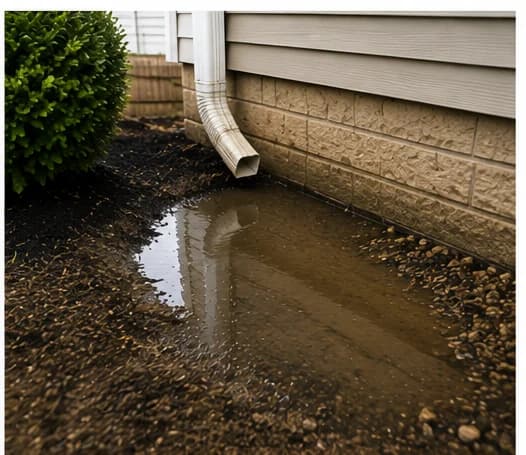
A dark, wet band along the wall after rain. Mulch that washes out. A puddle at the corner where two downspouts meet. Soil that stays soft in the first few feet out from the house.
You may also see water running along the foundation toward a low door, a walk, or a window well cover. The water is using the house as a dam because the ground next to it is flat or tilted inward.
- Puddles at downspout outlets next to the wall
- A soggy strip in the foundation planting
- Water flowing along the house instead of away from it
- A low spot against the foundation that holds every storm
Exterior reasons water collects there
Downspouts are the usual first suspect. A roof sheds a large volume of water onto a few outlets. If those outlets empty within a couple of feet of the wall, that burst soaks the same soil every storm. Downspout drainage is how that concentrated flow gets carried farther out.
The ground itself may slope toward the house. Even a gentle inward tilt will keep surface water against the wall. Nearby low spots — a settled walk, a planting bed, a dip at the corner — become the local pond.
Poor surface drainage along that strip means the water has no grate, no swale, and no fall. It waits next to the structure until it soaks in or evaporates.
What exterior drainage is for — and what it is not
Moving water away from the house reduces how long it sits against the wall. That can mean extending downspouts, reshaping the grade in the first several feet, adding a surface drain at a true low point, or installing a French drain where the soil along that strip stays saturated.
Exterior work manages water on the outside. It does not promise to dry the inside of the house. If water is already coming inside, that still needs its own evaluation. The pages on this site stay with the yard.
Which solution may fit the strip along the house
If the wettest ground is directly under a downspout, start with the downspout path. If the whole side of the house is a reverse slope, grading may be required before any pipe will help.
A catch basin can pick up a puddle at a corner or at the end of a walk — see catch basins and surface drains. A French drain can be relevant if the soil along the house stays saturated after surface water is no longer being dumped there.
The sequence matters. Roof water dumped onto a reverse slope will keep wetting the same strip. Yard drainage is the plan that puts those pieces in order.
What to look at along the foundation
- Where each downspout currently empties
- Whether the ground falls away from the wall or toward it
- Low spots in the first several feet out from the house
- Walks, steps, and planting beds that trap water against the wall
- A discharge location that will not send the same water back
Related drainage solutions
The goal is to keep exterior water from remaining concentrated alongside the house.